
Building a Data Center? The Secondary Market Belongs in the Sourcing Plan
By the Rare Recapture Team
AI is driving a historic data center buildout. But as operators plan what to buy, they should also ask what already exists.
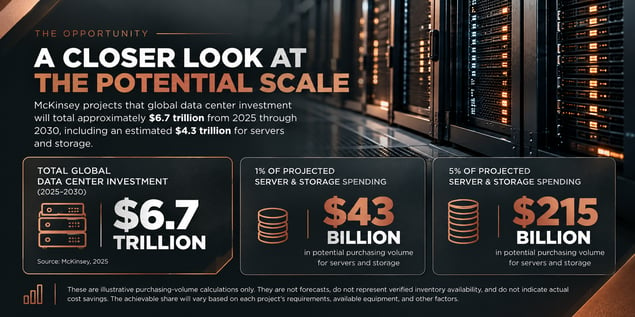
McKinsey projects that meeting global demand for data center capacity will require approximately $6.7 trillion in investment from 2025 through 2030. Its breakdown includes an estimated $3.5 trillion for servers and $0.8 trillion for storage. These are forecasts, not confirmed purchase orders, but they show how much equipment the industry may need to source.
A data center also needs networking, power distribution, cooling, and the systems that support its IT equipment. Each category has different performance, reliability, and design requirements.
The usual question is: How do we get all of that built?
Another question deserves a place at the planning table: Which requirements could be met with qualified equipment already in circulation?
Reuse can begin before a facility opens
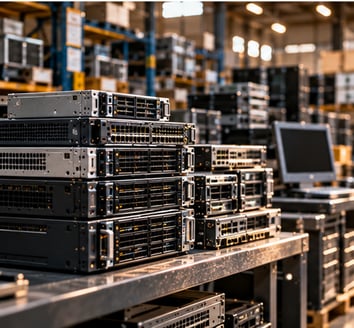
Data center reuse is often discussed at the end of a device’s life. A server is removed, its data is secured, and the operator decides whether to redeploy, resell, recover components, or recycle it.
Those decisions matter. But the secondary market can also be considered when a new environment is being designed and sourced.
Refurbished or recertified servers, storage, and networking equipment may fit particular workloads, expansion phases, or support environments. The Open Compute Project’s circularity work explicitly includes putting complete servers, switches, and other components into secondary installations. Its marketplace also lists remanufactured hyperscale compute solutions, although any supplier’s price or performance claims must be checked against the buyer’s requirements.
That does not mean every system should be sourced secondhand. The newest AI workloads may require accelerators, memory, cooling designs, and power densities that available secondary equipment cannot meet. The International Energy Agency reports that AI server power density rose sharply between 2020 and 2025 and is expected to rise further by 2027.
The opportunity is to match specific equipment to specific requirements, rather than applying one sourcing rule to an entire facility.
How much could come from the secondary market?
There is no credible industry-wide percentage we can apply to every new data center. A facility built for frontier AI training will have a different equipment profile from one supporting general compute, storage, backup, or mixed workloads. Inventory availability, equipment age, configuration, energy use, service support, and procurement standards all affect the answer.
McKinsey’s forecast provides a way to understand the potential scale, without pretending to know the achievable share. If just 1% of its projected $4.3 trillion in server and storage spending were fulfilled through qualified secondary equipment, that would represent $43 billion in purchasing volume. At 5%, it would represent $215 billion.
Those are illustrative calculations, not forecasts. They do not mean that this inventory exists, that it would meet buyers’ specifications, or that those amounts would be saved. They show why even a small eligible share is worth evaluating.
For an individual project, the useful answer comes from its actual equipment list. A sourcing review can sort requirements into three groups:
| Requirement | Sourcing Question |
| Core compute and AI systems | Does available equipment meet the workload, density, efficiency, and support requirements? |
| Storage and networking | Are compatible configurations available in the required quantities and timeframes? |
| Expansion and supporting workloads | Could qualified secondary equipment meet the need at an acceptable total cost? |
Every candidate should be assessed for provenance, testing, warranty and support, compatibility, expected energy use, security requirements, and total cost over its planned service life. A lower purchase price alone is not enough.
Build the next lifecycle into this one
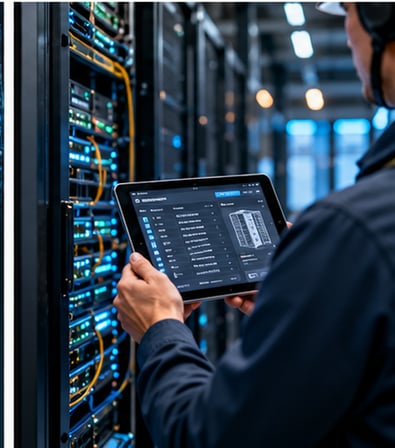 Sourcing is only the beginning. Equipment installed today will eventually be upgraded or retired. Planning for that moment early makes it easier to track assets, protect data, and identify equipment that may still have value.
That is the opportunity Rare Recapture sees across the technology lifecycle: evaluate what can be responsibly sourced, make informed decisions during refreshes, and recover value when equipment moves on.
The data center buildout needs new technology. It also calls for a better understanding of the technology we already have.
Every device has a best path. We’ll find it for you.